Early access · Research in progress
Every neurodivergent child is surrounded by people trying to help — a worried parent, a teacher with no spare hours, a specialist they see twice a year, or are still waiting to see. Each holds a different piece of the same child.
Almost none of it is in one place. We bring it together, then use AI to draft things that actually help this particular child — built from their own reports, their own interests, their own routines.
In practice: add whatever has been written about your child so far, even a single school report or letter, with or without a diagnosis, and get back a short briefing for the next adult who needs it, print-ready visual supports made around your child's own interests, and plain-English replies to your questions — each one a draft for you to check, linked to the documents it drew on.
How we use what you send us: privacy notice.
The problem
An Education, Health and Care Plan (EHCP) or other support plan. An educational psychology report. Speech and language assessments, occupational therapy notes, termly reviews, clinic letters, a behaviour plan. Each written by a different professional, at a different time, for a different reader.
They live in a cupboard, in an inbox, on a local authority portal, and in three different filing systems that don't talk to each other. So the same story gets retold from scratch to every new professional, and the person who most needs the whole picture — the parent — is the one holding the least organised copy of it.
For many families the folder is thin: a concern raised at school, a GP letter, a referral that has been waiting for a year or more. That is the stage we understand least well, and the one we most want to hear about.
Connecting those dots is the entire job. Not more information. The same information, finally usable by the people around the child.
What it does
Bringing the paperwork together is only half of it. The harder half is turning a pile of paperwork, which often contains dense professional terminology, into something practical — and that is where most families and schools run out of time.
Our AI reads everything in the child's file and drafts in minutes the resources that would otherwise take hours. Not generic templates with a name dropped in: each one is built from this child's documents, interests and routines. A staff briefing a supply teacher can read in a few minutes. A social story about the thing they are actually anxious about, using the characters they actually like. Answers to the intake form every new service sends, and a parent's views for a request to the local authority, drafted from what is already in the file.
And they come out designed and print-ready — properly laid out, illustrated around that child's own interests, ready for the wall or the book bag. That matters more than it sounds. Resources like these are meant to be ones a child recognises themselves in, but almost nobody in a family or a classroom is a designer, and making one by hand is an evening's work that most people simply never get to. This is the part that usually doesn't happen at all.
What a new adult needs to know before they meet the child, on two pages, with every point linked back to the report it came from.
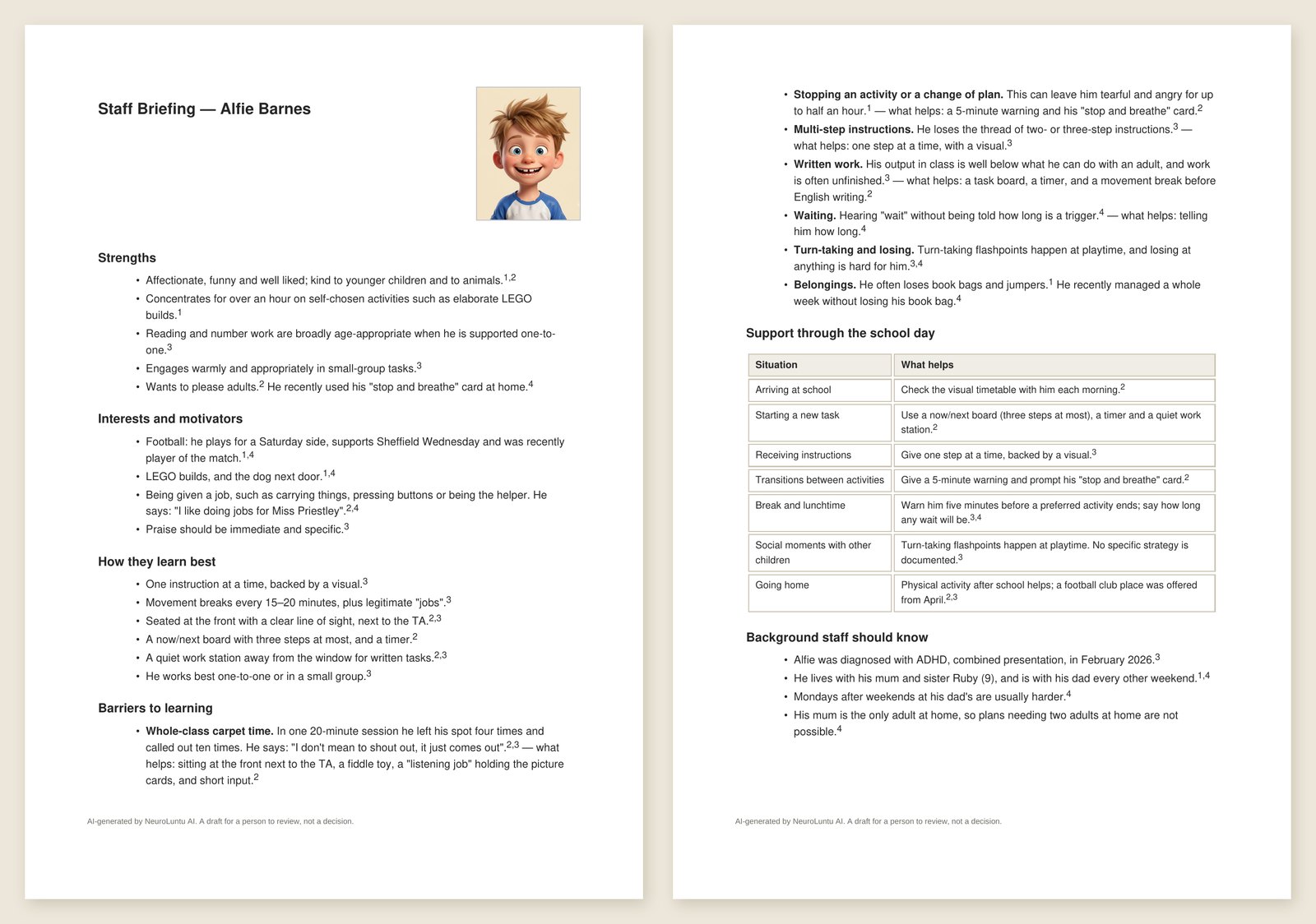
Example from the reports of a fictional child.
Illustrated, print-ready posters and tools built around their interests — social stories for a worry or an event, step-by-step schedules for a hard transition, calming toolkits drawn from what the reports say already works.
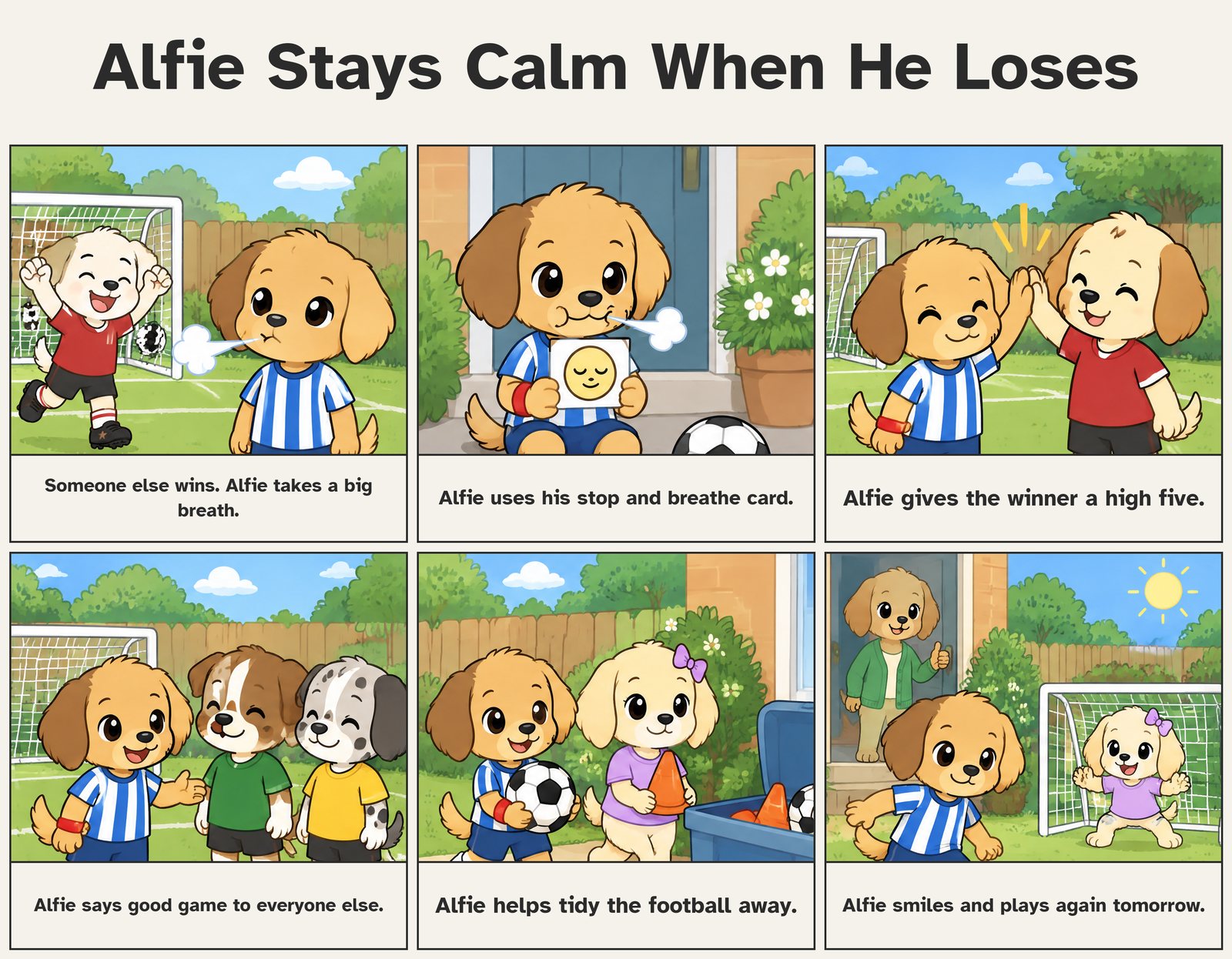
Example from the reports of a fictional child.
Answers for the forms services send, a parent's views for a local authority needs assessment request, and contributions to reviews, in the formal language each process expects.
Ask a question about the file and get a draft reply, cited back to the report it came from.
Every one is a draft for a human to check, linked back to the documents it drew on. The AI drafts; the adult who knows the child decides — and that review is the control, not a formality.
Who it's for
Designed first for parents and carers — and built to make working with schools and specialists easier, rather than adding another system for them to maintain.
The child is the whole point — every decision here is measured against whether their day gets better. The way we do that is by connecting and equipping the three groups of adults whose decisions shape it, so that everyone supporting that child is working from the same understanding of them.
It is why the name is what it is. NeuroLuntu takes its second half from the isiXhosa uluntu — humanity, community, the people — the same root as ubuntu.
The primary user
The journey is confusing, bureaucratic and emotionally exhausting. Medical and educational terminology sits between a parent and the only thing they actually want, which is for their child to do well.
One parent told us they were discharged after diagnosis with no roadmap at all, and accepted a plan they didn't understand because at least it was something.
And practitioners tell us the question parents ask most often is "Am I imagining it?" — that families need to be believed, and to hear what is good about their child, at least as much as they need information.
Make sense of it, and stay in control of who sees what.
The daily reality
There is never enough time or budget to support children the way schools would like to. Admin overhead eats the hours that should go to the child.
Getting to what matters for Tuesday's lesson shouldn't mean reading forty pages — and a child moving class or school shouldn't mean starting from nothing.
Less admin, so more of the resource reaches the child.
Context before the appointment
Specialist time is the scarcest thing in the system. Families often arrive carrying occupational therapy, educational psychology and school reports, and practitioners tell us that context is genuinely useful when it is organised rather than a pile to sift.
A clear summary of what is already documented before you meet the child, with each point traced back to the report it came from, so you can check it rather than take it on trust.
Better context, less chasing.
How we're building it
These aren't features. They're the rules the product is built inside — and with children's clinical data, they matter more than anything we could add.
Parents decide what is shared, with whom, and in how much detail — including how much a document reveals when it goes to school staff. Nothing spreads by default. This is the foundation everything else sits on.
Output is built to stay inside the child's own file, with what it says linked back to the passage it drew on, so you can check it against the source. Where the documents are silent, contradictory or out of date, our job is to surface that for a human rather than smooth it over.
It never diagnoses or hints at a diagnosis, never maps a child against clinical criteria, and never reasons about medication. It is not a diagnostic assessment and doesn't carry one out. It organises and explains what is already documented about a child's needs, so it works with or without a diagnosis.
Parents know their own child best, so nothing here explains their child back to them or talks down. Output is a draft to review, never an answer to act on unread. The people who know the child keep authority over anything that leaves the platform — and anything that does leave carries the label with it, in the file, not just on the screen.
Designed to WCAG 2.2 AA, with reduced motion and readability treated as requirements rather than polish. Many of the adults using this are neurodivergent themselves.
A record home and school both see could easily make a parent feel monitored, or a teacher feel scrutinised. We treat that as the most likely way this goes wrong, and test features against it: does this make the relationship between a family and a school more open, or more careful? A feature that improves information and leaves either side more guarded has failed.
Data & trust
If you work in special educational needs and disabilities (SEND) you will want to know exactly what happens to a child's documents before you would recommend anything to a family. So do we, before we ask anyone to rely on it. Rather than a polished policy page that outruns the product, here is an honest split of what is decided and what is not.
These are being worked through with professional advice, because getting them wrong would matter far more than moving quickly. If you want to interrogate any of it, that is a conversation we actively want — it is part of why we are doing research now rather than selling.
It's built, and it works. It reads real documents, drafts resources from them, and a family has already used it on its own child's reports.
We're pre-launch by choice. Before this goes further we want it shaped by the people who would have to live with it — so right now we're in research rather than selling, and we won't claim outcomes we haven't measured yet.
"It would have been most useful right at the beginning — when I understood the least and had to make the biggest decisions."
Parent of a teenager with an EHCP, research session, 2026
"'Am I imagining it?' — honestly it is so common that they question themselves and want validation. It also really helps families to hear the positives about their child."
Development therapist at a children's charity, research session, September 2026
Get involved
We're speaking with parents and carers, including families still waiting for an assessment, SENCos and teachers, and clinicians working in SEND. Usually a short conversation, sometimes a look at the prototype, always shaped around what you'd actually need it to do.
No preparation needed, and no commitment beyond the conversation.
How we use what you send us: privacy notice.
If you're a school or service wondering whether this could help, an enquiry is welcome too — we'd rather hear what you need early than guess at it.